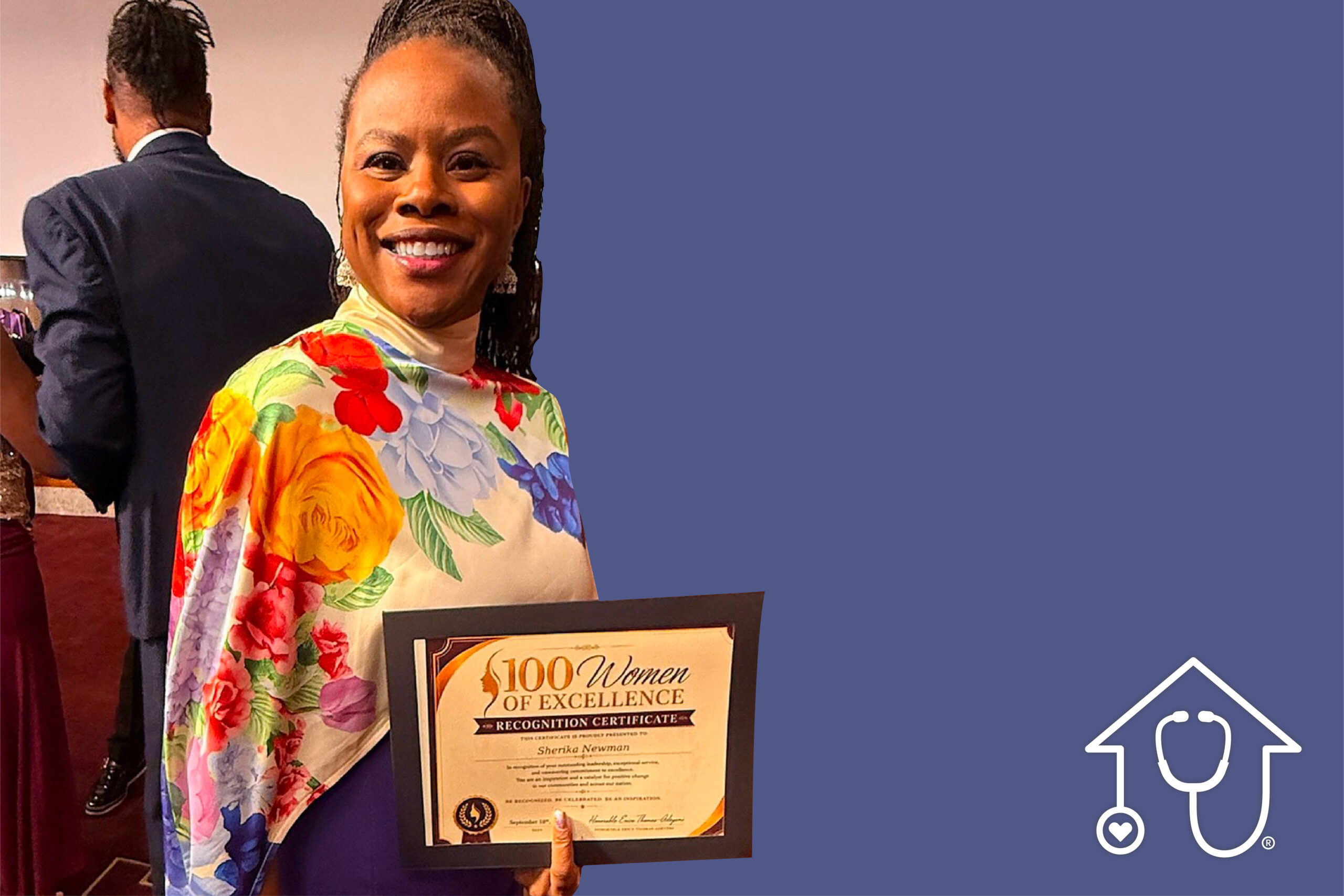
100 Women of Excellence
What she didn’t know was that her team had secretly submitted her nomination, wanting to recognize her impact in clinical leadership, community service, and patient advocacy. The annual awards – held during Congressional Black Caucus Week on Capitol Hill – honor extraordinary women making a difference in fields like medicine, law, and public service.
We recently sat down with Dr. Newman to talk about what this award means to her, her deep commitment to trauma-informed care, and how her work at WellBe Senior Medical aligns with her lifelong passion for advocacy.
For Dr. Newman, a palliative care physician and clinical leader at WellBe Senior Medical, the recognition was a meaningful milestone:
“To have other people recognize your commitments and what you’re contributing to, it’s phenomenal… To see someone else say, ‘This is important to us as a community,’ an outcome I never expected. It felt like, wow, people see me that I didn’t even know were looking.”
Putting People First
Whether caring for patients directly or advocating for families behind the scenes, her goal is always to support patients on their own terms.
“I like that I’m with a company whose values align with mine, whose goals align with mine. That we are here to do our best to help people.”
She adds that true patient care requires ongoing listening.
“Sometimes it can get hard when you’re a provider or social worker… because you want to save people, and sometimes the way we want to help people is not how they need help. So, we have to keep talking to them about what their needs are, not just how we want to help them.”
Championing Trauma-Informed Care
Facing a serious illness is scary. When providers only look at what is medically wrong without considering a patient’s personal history, they risk re-traumatizing them.
Dr. Newman learned this firsthand early in her career while caring for a young woman with terminal cancer who refused to let staff contact her family. Instead of writing her off as “difficult,” Dr. Newman shifted the question from “What’s wrong?” to “What happened?” That shift revealed deep trauma – and ultimately allowed the patient to reconnect with her sister, so she didn’t have to face end-of-life care alone.
Fuel from Capitol Hill
“Meeting other women of other disciplines, law, medicine, veterans, all sharing what they’re doing for their community and what they’re spearheading – it gave me goosebumps. It felt so surreal. It waw like being in a room with a powerhouse, like a think tank of all these women… That kind of stuff, it gives you fuel to keep going, and it did.”
Finding Your “Golden Ticket”
“We’re all designed for success but programmed for failure. And if we just deprogram and get back to our original design, we will naturally tap into our leadership skills, and I think the passion for it, like the passion of a little kid, will drive us.”
For her, true leadership comes from channeling what you’ve always cared about into a tool to help others:
“I’m going to speak up for someone who can’t speak up for themselves. I ask their permission, and I do it in a respectful way… But I am going to do it. It’s the little kid in you that can’t help but do the thing you want to do. That’s your leadership. That’s your golden ticket.”